The comprehensive design optimization knowledge is used to optimize the crush can in Rivian R1T. The optimum design is able to reduce total mass by 20% and increased the performance by 12% in IIHS frontal crash load case.
This article is mainly focused on discussing design optimization in methodology perspective. None of confidential information will be included.
What is Design Optimization
Optimization is backward design with inverse analysis using mathematical methods.

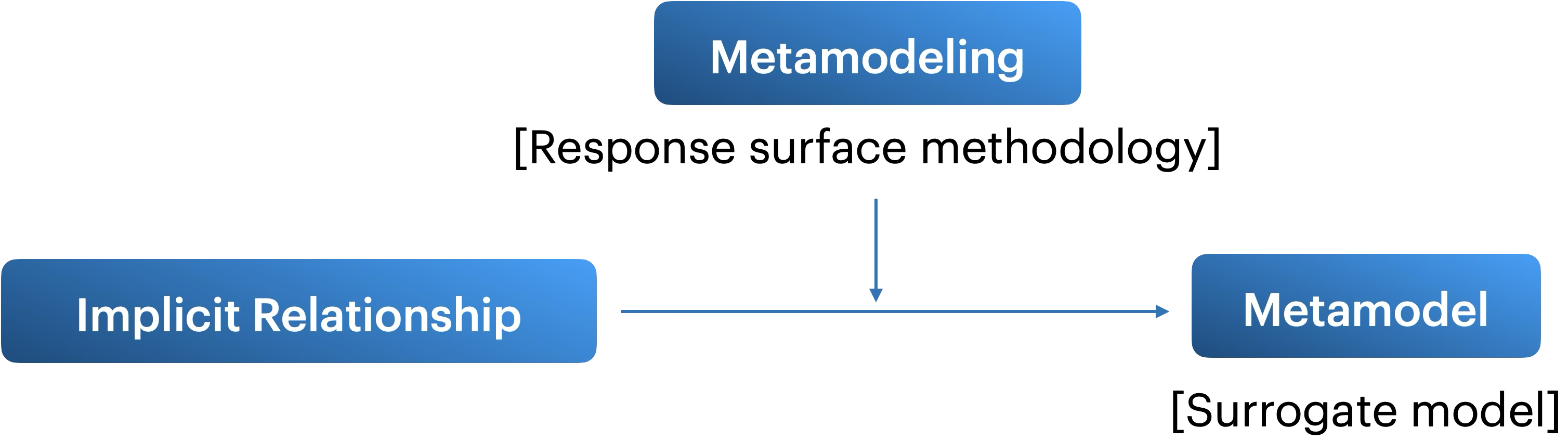
How to Find Implicit Relationship
It is feasible to find an explicit approximate function of true responses using sampling points from design of experiment (DoE).

The statistical method to find an explicit mathematical model to represent this implicit relationship is called metamodeling (also known as response surface methodology). This explicit mathematical model is called metamodel (also known as surrogate model).
Optimization Problem

Optimize front-end crash structure (such as a crash-can) to achieve:
⬇️ Weight and cost
⬆️ Energy absorption efficiency
⬆️ Crash safety performance
✅ Allowable crushing force
❎ Interference against proximities
Design Variables
In order to simplify the engineering problem and use first principles, design variables are divided into two priority categories:
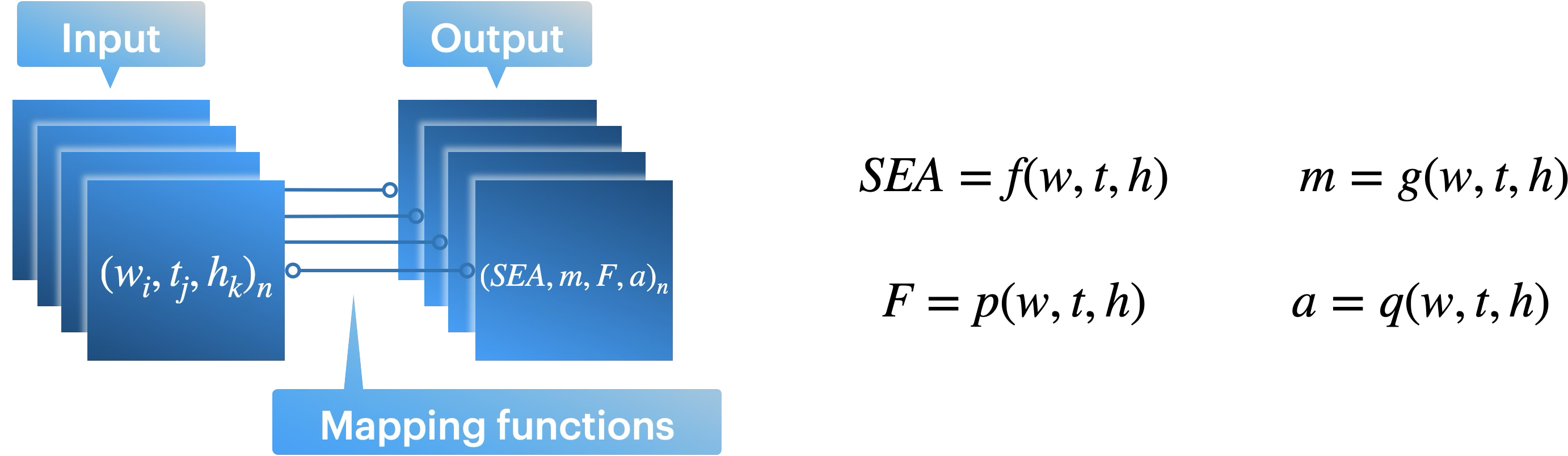
First priority (geometric variables): such as width (w), height (h), thickness (t), etc.
Second priority (auxiliary variables): such as fillet radius, material property variation, tapered angle, small feature location, etc.
Objective Functions
For crash structures, the general objectives are usually among: specific energy efficiency (SEA), mass (m), crush force (F), and impact pulse (a), etc.
DoE with Sampling Points
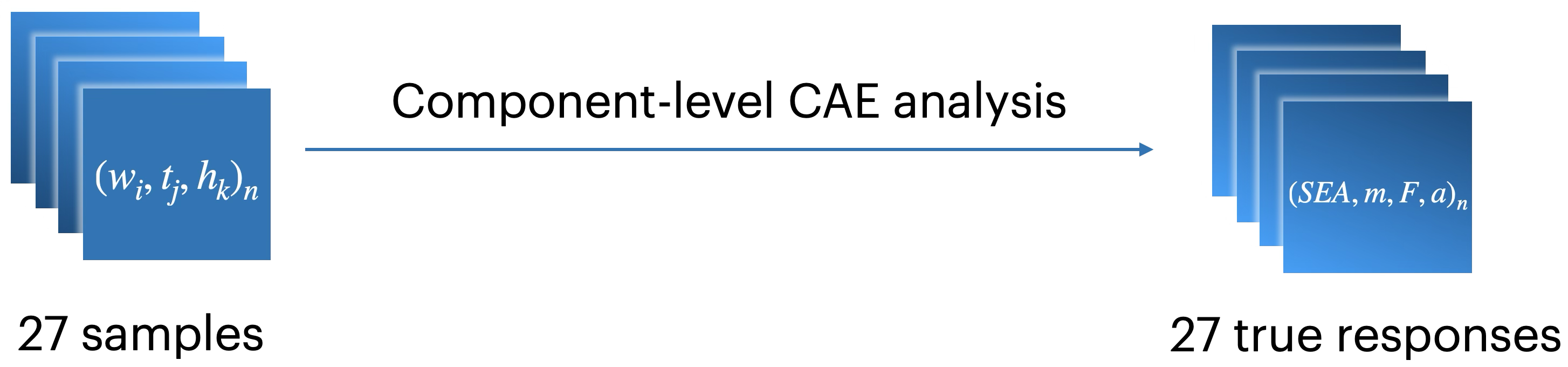
Full factorial design (FFD) is a widely used method to generate sampling points from DoE. For example, for 3 variables each with 3 levels, a total of 33 = 27 samples are generated. If with too many design variables, Taguchi orthogonal array (OA) method is preferred. If the design variable has too many levels, Latin hypercube sampling (LHS) method can be adopted.
True response from sampling points can be obtained by running CAE analysis.
Metamodeling
Metamodeling is to find the mapping function between inputs and outputs.
Polynomial regression (PR) is efficient for low-order response but needs statistical accuracy check with mathematical model shows as

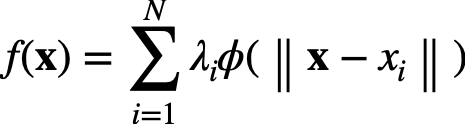
Radial basis functions (RBF) is good for highly nonlinear response and big dataset. There is no error at sampling points. Its mathematical model is
We can now represent the implicit relationship using explicit mathematical models, and then the optimum design within design domain can be determined.
Project Impact
I used design optimization knowledge to help Rivian optimize the crush can in R1T with total mass and bill of material reduced by 20% and IIHS intrusion performance increased by 12%.

 Zheng Li
Leave a comment